
Invisible Ink Label Printing
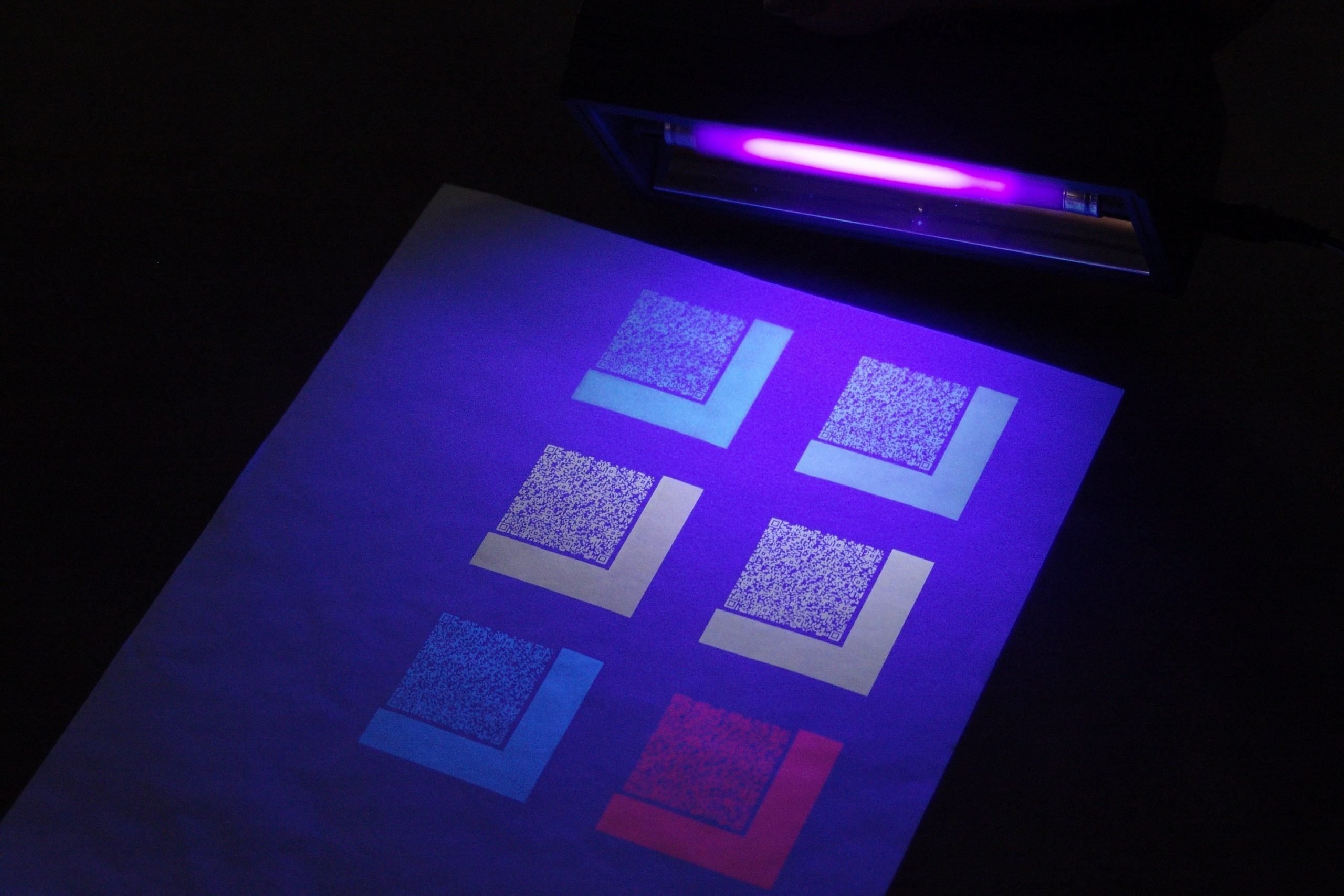
UV fluorescent marks can be designed to be difficult to notice in normal light and visible under a compatible UV source. They may support product checks as part of a wider verification process, but a fluorescent mark alone does not prove authenticity or prevent copying. Ink, substrate, equipment and sample requirements must be confirmed for each project.
How It Works
The intended effect is a fluorescent response under a compatible UV source. Daylight visibility, colour and contrast depend on the selected ink, substrate, print coverage, finish and viewing conditions. Confirm the ink supplier’s specifications and test a printed sample with the equipment intended for use.
On small screens, swipe the table left or right to view all columns.
| Ink type | Appearance in daylight | Under UV |
|---|---|---|
| Low-visibility UV fluorescent ink | May be difficult to notice; verify on the actual label | Response and colour depend on the selected ink and UV source |
| Tinted UV fluorescent ink | May show a visible tint | Confirm fluorescence and contrast on a sample |
| Specialist multi-response ink | Subject to the selected formulation | Availability, excitation wavelengths and responses require supplier confirmation and sample testing |
Specialist ink responses may add a comparison step, but no resistance-to-copying level is claimed here. Agree the inspection method and acceptance criteria before ordering. Use compatible equipment according to its manufacturer’s operating and safety instructions.
Possible Mark Designs
- Logo or wordmark — compare the mark with an approved reference under agreed lighting
- Hidden text — a low-visibility word or phrase, subject to sample approval
- Serial numbers — variable data is subject to process feasibility, data controls and verification-system requirements
- QR codes — readability must be tested with the intended lighting, scanner and verification service
- Pattern fills — may support visual comparison; detection of cutting or reuse must be validated for the proposed design
- Micro detail — minimum detail size and inspection method require production trials
Potential Applications
On small screens, swipe the table left or right to view all columns.
| Industry | Inspection objective to discuss |
|---|---|
| Wine and spirits | Label checks alongside measures addressing bottle refilling and label reuse |
| Pharmaceutical | Packaging checks subject to the product’s applicable requirements; no regulatory approval or product-safety assurance is implied |
| Cosmetics | Brand and distribution-channel checks |
| Automotive and electronics parts | Component-label checks within warranty and repair procedures |
| Agrochemicals | Packaging checks alongside applicable product and supply-chain controls |
| Brands with distributor territories | Territory-code comparison against controlled distribution records |
A territory code may help trace the intended market when it is linked to reliable distribution records. The code alone does not establish the actual route of sale or whether the product is genuine.
Verification in Practice
Select the inspection equipment after confirming the ink’s requirements. Check that the intended operators can consistently recognise the approved response in realistic lighting. Equipment cost and inspection time depend on the agreed method.
On small screens, swipe the table left or right to view all columns.
| Who checks | Where |
|---|---|
| Authorised inspection personnel | Agreed equipment and inspection procedure |
| Distributors and wholesalers | Incoming goods check |
| Retail staff | Point of sale, when a customer queries authenticity |
| Your own field team | Market audits and grey-market investigation |
Agree reference samples, viewing conditions, acceptance criteria and any retention requirements before placing an order. Sample availability, quantity and cost must be confirmed in the quotation; they are not automatically included with every order.
Combining Security Features
A combination of features may support a broader verification process. Its effectiveness depends on implementation, record keeping and inspection; no feature or combination is presented as counterfeit-proof. Confirm availability and compatibility for the proposed label.
On small screens, swipe the table left or right to view all columns.
| Feature | Possible check and limitation |
|---|---|
| Invisible UV ink | Compare with an approved reference using compatible equipment |
| Microprinting | Inspect agreed detail with suitable magnification; validate legibility |
| Guilloche pattern | Compare fine-line detail; resistance to reproduction depends on the design and process |
| Variable serial number | A configured database can check a code and recorded scan history; a valid code can still be copied |
| Foil or holographic element | Visual comparison with a reference; appearance alone does not prove authenticity |
A project could combine a UV mark, fine printed detail and a variable code, subject to production feasibility and an agreed verification service. Printing a code does not by itself provide a database, tracking service or authentication system.
Practical Notes
On small screens, swipe the table left or right to view all columns.
| Substrate | Confirm ink compatibility, adhesion and visual contrast on the exact paper or film, including any coating or laminate. Approve a sample before production. |
|---|---|
| Optical brighteners | Check the substrate’s own response under the intended UV source, as it may affect mark contrast. Any requirement for stock without optical brighteners must be confirmed with the supplier. |
| Placement | Position the mark where it will not be obscured by a cap, a shrink band or an over-label. |
| Confidentiality | Agree who may access the artwork, reference samples and inspection instructions. Confidentiality supports the process but does not guarantee protection against copying. |
| Sampling | Sampling method, ink availability, sample quantity, setup charges and lead time depend on the proposed process. A general digital-printing minimum does not establish feasibility for invisible-ink samples. Confirm the sampling plan in the quotation. |
Other printing and security processes → · Materials and finishes →
Planning a UV Mark for Your Labels?
Tell us the product, substrate, intended market, inspection equipment and expected use conditions. We can review the requirements and confirm available options, testing needs and sampling terms before quoting.